VA Construction Loan: Build With $0 Down (Construction-to-Permanent)
A VA construction loan is a lender-issued construction-to-permanent program backed by the Department of Veterans Affairs. Eligible veterans, active-duty service members, and qualifying surviving spouses can use it to finance land (when allowed), a construction draw schedule during the build, and permanent VA financing—often with no down payment for borrowers with full entitlement and no PMI, subject to lender approval. Many borrowers choose a one-time close construction-to-permanent structure so construction and permanent financing close once before building starts. Plain English: A VA construction loan helps eligible borrowers finance building a primary residence—usually with draws during construction—then convert into a permanent VA mortgage when the home is finished (construction-to-permanent / one-time close or two-time close). Because not every VA lender offers construction, start by comparing VA construction loan lenders that serve your property location. Funds are released in draws as construction milestones are completed and inspected—use our interactive draw calculator and 2026 benchmarks to model interest-only payments during the build. After final inspection and Certificate of Occupancy, the loan converts to a standard VA mortgage (one-time close) or closes again into permanent financing (two-time close), depending on the construction-to-permanent program you choose.
How the VA construction loan works, in 90 seconds
A 90-second National VA Loans explainer covering how a VA construction loan finances land and a custom build in inspection-backed draws, then converts to a permanent VA mortgage—often with $0 down, no PMI, and one-time or two-time close options for eligible veterans.
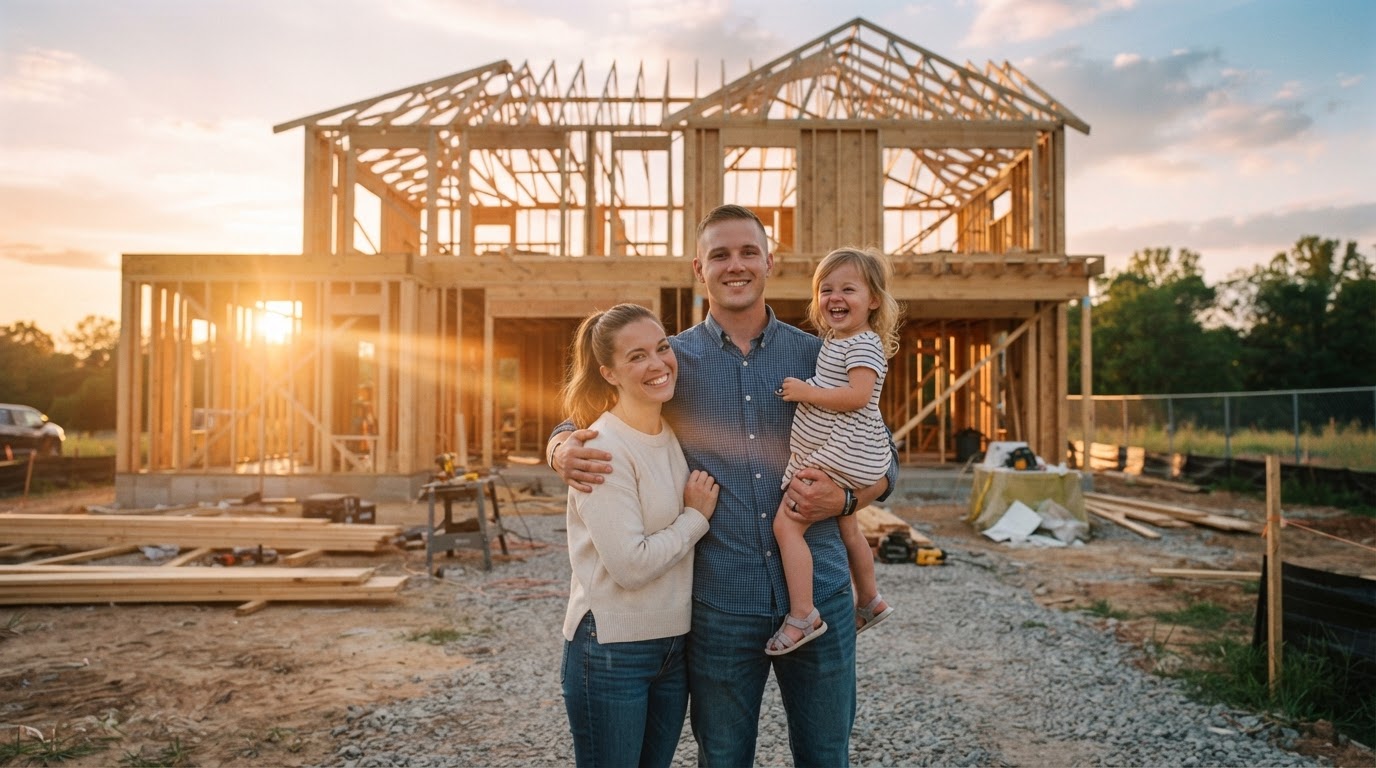
Voiceover transcript. Building a home is one of the biggest steps a veteran can take. And thanks to your service, you don't have to build it alone. A VA construction loan is a construction-to-permanent mortgage, backed by the Department of Veterans Affairs. It finances your build in draws, then converts to a standard VA mortgage the day you move in. For eligible borrowers with full entitlement, that means zero dollars down. No PMI. Your rate depends on your credit, loan terms, and market conditions. Your lender provides your actual rate and terms. You'll choose between two structures. A one-time close wraps construction and permanent financing into a single closing. Simpler. More predictable. A two-time close lets you re-shop the permanent rate after the build. Funds release in draws, after each phase passes inspection. Foundation. Framing. Rough-in. Interior. Final. You pay interest only on what's drawn, until the home is complete. Getting one takes five steps. Find a construction-experienced VA lender. Pre-qualify and confirm your entitlement. Pick a licensed, insured builder. Submit plans and appraisal. Then close, build, and pass final inspection. Most builds take twelve to eighteen months. Ready to build? Pre-qualify in minutes at National VA Loans dot com. Or call 855-956-4040. National VA Loans. Homes for the Brave.
Explainer chapters
- From blueprint to keys. How the VA Construction Loan works, in 90 seconds.
- What is a VA construction loan?. A construction-to-permanent mortgage that finances the build in draws, then converts to a standard VA mortgage.
- Why veterans choose it. $0 down possible with full entitlement and lender approval, and no PMI.
- One-time close vs two-time close. One closing before the build, or a second closing after final inspection to re-shop the permanent rate.
- Construction draw schedule. Funds release after inspection: foundation, framing, rough-in, interior, and final. Interest only on amounts drawn.
- Five steps to groundbreaking. Find a construction lender, pre-qualify, select a licensed builder, submit plans, then close and build.
- Pre-qualify to build. Pre-qualify in minutes or call a VA construction specialist.
What is a VA construction loan?
A VA construction loan is a lender-issued construction-to-permanent program backed by the Department of Veterans Affairs. Eligible veterans, active-duty service members, and qualifying surviving spouses can use it to finance land (when allowed), a construction draw schedule during the build, and permanent VA financing—often with no down payment for borrowers with full entitlement and no PMI, subject to lender approval. Many borrowers choose a one-time close construction-to-permanent structure so construction and permanent financing close once before building starts.
Plain English: A VA construction loan helps eligible borrowers finance building a primary residence—usually with draws during construction—then convert into a permanent VA mortgage when the home is finished (construction-to-permanent / one-time close or two-time close). Because not every VA lender offers construction, start by comparing VA construction loan lenders that serve your property location.
How does a VA construction loan work?
Funds are released in draws as construction milestones are completed and inspected—use our interactive draw calculator and 2026 benchmarks to model interest-only payments during the build. After final inspection and Certificate of Occupancy, the loan converts to a standard VA mortgage (one-time close) or closes again into permanent financing (two-time close), depending on the construction-to-permanent program you choose.
Why use a VA construction loan?
- Potential $0 down payment for eligible borrowers with full VA entitlement
- No private mortgage insurance (PMI) on qualified VA construction-to-permanent loans
- Your rate depends on your credit, loan terms, and market conditions. Your lender provides your actual rate and terms.
- One-time close options can reduce duplicate closing costs and paperwork
- Designed for primary-residence custom builds when property and builder requirements are met
VA construction loan requirements checklist
- Eligible veteran, active-duty, Guard/Reserve, or qualifying surviving spouse with valid COE
- Credit, income, debt, and residual income that meet lender overlays (many lenders look for mid-600s credit or higher)
- Licensed, insured builder approved by your construction lender
- Plans, specs, cost breakdown, permits, and plans-based VA appraisal support
- Land that is buildable, properly zoned, and titled with the home as real property
- Permanent foundation, VA minimum property requirements (MPRs), and draw inspection compliance
- Cash reserves for soft costs, inspections, and contingency change orders
Typical VA construction draw schedule
Most lenders release funds in phases after inspection. Your builder contract and lender program define exact percentages. VA Construction Loan Calculator.
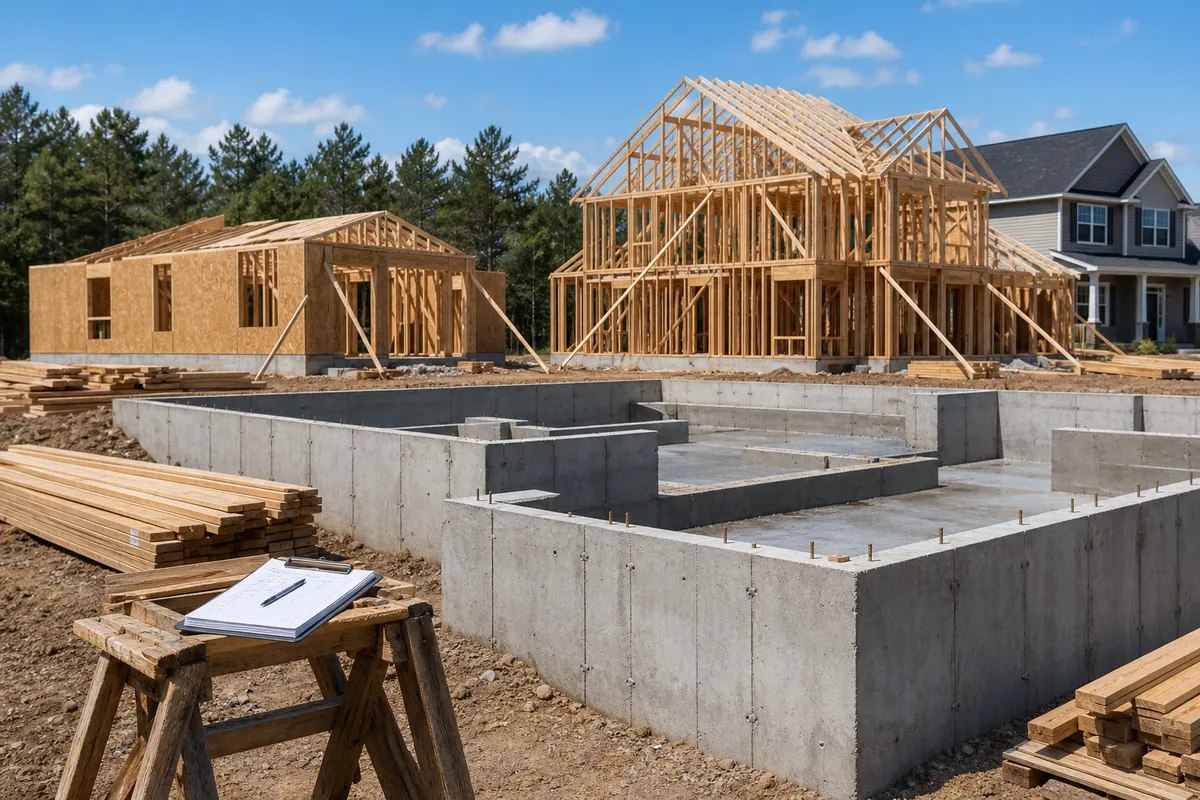
| Phase | Typical draw | What is verified |
|---|---|---|
| Foundation & site prep | 10–20% | Initial draw after footing and foundation inspection |
| Framing & dry-in | 20–30% | Roof, windows, and exterior shell milestones |
| Mechanical rough-in | 15–25% | Plumbing, electrical, and HVAC rough inspections |
| Interior & finishes | 20–30% | Drywall, cabinets, flooring, and trim progress |
| Final completion | 10–20% | Certificate of Occupancy and final compliance inspection |
VA Construction Draw & Soft-Cost Benchmarks 2026
Ranges reflect common lender construction draw schedules and industry soft-cost planning bands used on VA construction-to-permanent programs. Exact percentages are set by your lender, builder contract, and local inspection milestones—not by the VA as a fixed national schedule.
Soft costs typically 8–15% (typical 10%). Contingency typically 5–15% (typical 10%). Cash reserves often 2–5%.
Standard (6 draws)
Balanced schedule used by many construction lenders
| Phase | Typical draw | What is verified |
|---|---|---|
| Foundation | 15% | Footing and foundation inspection |
| Framing | 20% | Structural framing complete |
| Roof / Windows | 15% | Dry-in shell milestones |
| Rough-in | 15% | Mechanical rough inspections |
| Interior | 20% | Finish progress verified |
| Final | 15% | CO and final compliance inspection |
Industry phase ranges
| Phase | Typical range | Notes |
|---|---|---|
| Foundation & site prep | 10–20% | Initial draw after footing and foundation inspection |
| Framing & dry-in | 20–30% | Roof, windows, and exterior shell milestones |
| Mechanical rough-in | 15–25% | Plumbing, electrical, and HVAC rough inspections |
| Interior & finishes | 20–30% | Drywall, cabinets, flooring, and trim progress |
| Final completion | 10–20% | Certificate of Occupancy and final compliance inspection |
Estimates only. Not a commitment to lend. Program availability, overlays, and draw rules vary by lender and project. Always confirm with your construction lender before signing a build contract.
Last reviewed June 2026. Reviewed by Jeff Newton, Mortgage Loan Manager.
How to get a VA construction loan
- Find a VA construction-experienced lender — Not every VA lender offers construction. Compare programs, overlays, one-time close availability, and timeline expectations before you commit to a builder.
- Request Pre-Qualification and confirm entitlement — Verify your Certificate of Eligibility (COE), income, credit, debts, and remaining VA entitlement. Pre-Qualification helps set a realistic construction budget and land price range.
- Select a licensed, insured builder — Your lender will vet builder licensing, insurance, experience, and draw-process readiness. Start builder verification early—delays here are one of the most common bottlenecks.
- Submit plans, specs, permits, and appraisal support — Provide architectural plans, detailed cost breakdowns, permits (or applications), and plans-based appraisal materials. The VA appraiser issues a Notice of Value (NOV) when the project meets VA minimum property requirements (MPRs).
- Close, build with draws, pass final compliance — Close on the construction phase, fund draws after inspections, and complete a final compliance inspection before permanent conversion or final closing. Keep contingency reserves for change orders and timeline slips.
One-time close vs two-time close
Prefer a deeper walkthrough? Read the full VA one-time close construction loan guide.
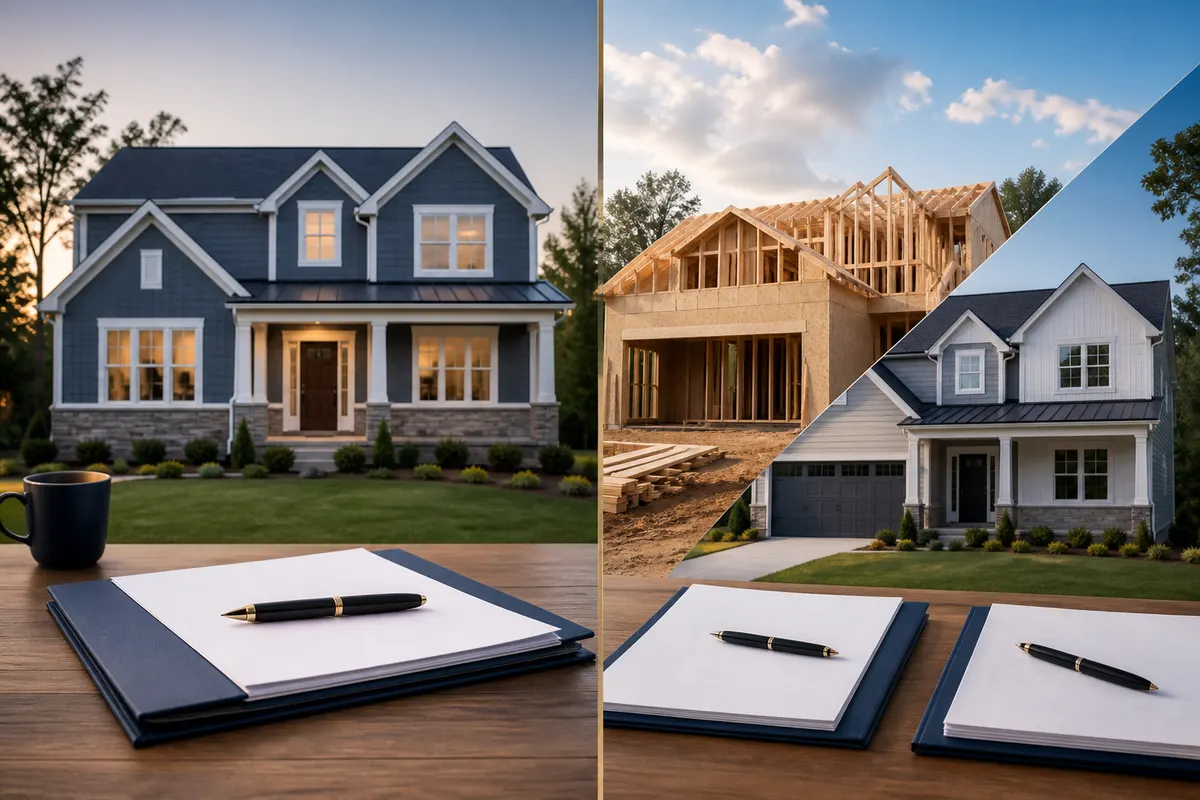
| Factor | One-time close | Two-time close |
|---|---|---|
| Closings | Single closing before construction starts | Construction closing, then permanent closing after build |
| Closing costs | Typically paid once | Two sets of closing costs possible |
| Rate lock | Permanent terms often locked upfront | May re-shop permanent rate at conversion |
| Flexibility | Less flexibility to change lenders later | More flexibility, but second-loan approval risk |
| Best for | Borrowers who want simplicity and cost certainty | Borrowers optimizing rate after completed value is known |
VA construction loan vs conventional construction
| Topic | VA construction loan | Conventional construction |
|---|---|---|
| Down payment | Often $0 with full entitlement; reserves still recommended | Often 20% or more for construction products |
| Mortgage insurance | No PMI | PMI or higher pricing common with low down payment |
| Credit overlays | No VA minimum score; lenders set overlays (often mid-600s or higher) | Often mid-600s+; overlays vary by lender |
| Builder standards | Licensed, insured builder vetted by lender; plans must meet VA MPRs | Licensed builder requirements vary by lender |
| Funding fee | VA funding fee may apply; disability exemption possible | No VA funding fee |
How to choose a VA construction loan lender
Not every VA lender offers construction. Searching for VA construction lenders, a VA construction loan lender near you, or VA construction loan lenders that serve your market usually means finding a specialty construction-to-permanent shop—not a generic purchase lender. National VA Loans helps eligible borrowers Pre-Qualify and compare construction-experienced options; we do not publish ranked “best lender” lists or claim every lender serves every ZIP code.
“Near me” for VA construction loan lenders usually means a lender that can finance your property location and work with local builders, inspectors, and draw schedules—even if the loan team is not in the same city. Confirm state licensing, construction program availability, and whether one-time close is offered where you are building.
What to compare across VA construction lenders
- Construction program experience — Ask how many VA construction or construction-to-permanent files they close each year, and whether they support one-time close vs two-time close.
- Builder and draw process — Confirm how they vet builders, schedule inspections, and release draws. Weak draw processes are a common bottleneck.
- Overlays and timeline — Compare credit, reserve, and documentation overlays, plus realistic timelines from Pre-Qualification to construction start.
- Pricing transparency — Request clear rate, fee, and lock/extension expectations for the construction phase. The VA does not set rates—your lender does.
- Property location coverage — Verify they lend in your county/state and understand local permitting, appraisal, and MPR realities for new builds.
Questions to ask a VA construction loan lender
- Do you currently offer VA construction or construction-to-permanent loans for my property state?
- Is one-time close available, or only two-time close?
- What builder licensing, insurance, and draw experience do you require?
- How many draws are typical, and who orders inspections?
- What credit, reserve, and contingency overlays apply beyond VA guidelines?
- How long do similar files usually take from application to groundbreaking?
This guide is educational. Lender availability, overlays, rates, and fees vary and are subject to lender approval. Pre-Qualification is not a commitment to lend. National VA Loans is not affiliated with the Department of Veterans Affairs or any government agency.
Related VA construction guides
- VA one-time close construction loan guide
- VA construction loan Texas
- VA construction loan Florida
- VA Construction Loan Availability Index
- Building your dream home with a VA construction loan
- VA construction loan checklist
- VA Construction Loan Calculator
Official VA resources
VA Construction Loan FAQs
Costs & Fees
How much does a VA construction loan cost?
VA construction loans typically have similar rates to standard VA loans, though construction phases may carry slightly higher rates. You'll also pay the VA funding fee (1.25-3.3%), closing costs (2-5%), and potentially a separate closing for the construction phase.
Do I need a down payment for VA construction loans?
Like standard VA loans, VA construction loans don't require a down payment for eligible veterans. However, having some cash reserves (typically 2-5% of project cost) helps cover closing costs, inspections, and unexpected expenses during construction.
What's included in "soft costs" for construction?
Soft costs include non-construction expenses: permits, architectural plans, engineering reports, surveys, soil tests, utility hookups, inspections, and loan fees. These typically add 8-15% to your base construction budget.
Builder Requirements
What makes a builder "VA-approved"?
The VA doesn't formally "approve" builders like it does lenders. Instead, your lender verifies builder qualifications: valid state licensing, adequate insurance (liability and workers comp), financial stability, and experience with construction loans.
Can I use any builder I want?
You can choose your builder, but they must meet your lender's requirements. This typically means proper licensing, insurance coverage ($1M+ liability is common), workers compensation, and demonstrated experience. Your lender will verify these credentials.
Can I act as my own builder (owner-builder)?
Owner-builder VA construction loans are rare and difficult to obtain. Most lenders require a licensed general contractor because the VA and lender need assurance that the home will be completed properly and meet all codes.
Is there a VA builder ID lookup or a public list of VA approved builders?
No public consumer directory covers every VA approved builder, VA certified builder, or VA home loan approved builder. People searching “VA builder ID lookup,” “VA builder ID search,” or “VA approved contractors list” are usually looking for a VA builder registration number. The VA does not publish a nationwide approved-builders list for shoppers. Your lender verifies the builder’s license, insurance, and ability to work with construction draws. A builder ID inside VA systems is an industry identifier, not a badge you can look up on this site.
Is a VA lender ID lookup the same as a builder ID search?
No. A VA lender ID identifies a VA-approved mortgage lender inside VA systems such as WebLGY. A builder ID, when one is used, identifies a builder on a construction file. Neither lookup is a public search tool for homebuyers. Confirm a lender through its NMLS record and confirm a builder through state licensing plus your lender’s construction review. VA approved contractors for a renovation or new build still have to pass that lender review.
Draws & Payments
How do construction draws work?
Draws are periodic disbursements from your loan to pay the builder as construction progresses. After each phase completion (foundation, framing, etc.), an inspector verifies the work, and the lender releases the next draw payment.
What do I pay during construction?
During construction, you typically pay interest-only on the amount that's been drawn. This starts small and increases as more funds are released. After completion, your loan converts to a standard principal + interest mortgage payment.
When does the loan convert to a permanent mortgage?
Conversion happens after construction completion, final inspection, and Certificate of Occupancy issuance. With a one-time close loan, terms are already set. Two-time close loans require a separate closing for the permanent mortgage.
What are typical VA construction draw percentages in 2026?
Illustrative VA construction draw schedules often use 5–8 draws. Common planning bands include foundation 10–20%, framing/dry-in 20–30%, mechanical rough-in 15–25%, interiors 20–30%, and final completion 10–20%. Exact percentages are set by your lender and builder contract—not a single VA-mandated national schedule.
What soft-cost and contingency percentages should I budget?
Soft costs (permits, plans, surveys, utilities, inspections, loan fees) commonly add about 8–15% to base construction cost, with ~10% typical. Contingency reserves of 5–15% (often ~10%) help cover change orders and delays. Many borrowers also keep 2–5% cash reserves for closing and inspection cash flow.
Land Purchase
Can I get a VA land loan, or include land in a VA construction loan?
The VA home loan program is not a standalone vacant-land loan. A VA land loan search usually leads back to construction financing: some VA construction loans can include the lot when you are building a primary residence, and others require you to already own the land. Raw land with no build plan is generally not eligible.
What if I already own land?
If you already own land free and clear, you may be able to use its equity toward your construction project, potentially reducing the loan amount needed. Land with an existing mortgage may need to be refinanced or paid off.
Are there land requirements for VA construction loans?
Land must be suitable for residential construction: proper zoning, buildable topography, utility access (or feasible alternatives), and clear title. Some programs have acreage limits or require the land to be in certain conditions.
Eligibility & Documents
What documents do I need for a VA construction loan?
Standard VA loan documents plus: detailed construction plans and specs, builder contract, builder credentials (license, insurance, references), cost breakdown, building permits (or application), and appraisal based on plans/specs.
Is it harder to qualify for a VA construction loan?
Yes, requirements are typically stricter. Many lenders want higher credit scores (640-680+), stronger reserves, and more documentation. The construction aspect adds complexity and risk from the lender's perspective.
How long does VA construction loan approval take?
Initial approval takes 30-45 days typically, but the overall process from application to construction start can take 60-90+ days. Builder approval, plan review, permits, and appraisal all add time beyond standard loan processing.
Program Basics
What is a VA construction loan?
A VA construction loan is a construction-to-permanent mortgage backed by the VA that helps eligible borrowers finance building a primary residence, including land in some programs, with draws paid to the builder as work is completed and inspected.
What are VA construction loan requirements?
You need VA eligibility, lender-approved credit and income, a licensed insured builder, approved plans and permits, plans-based appraisal with Notice of Value, permanent foundation, real-property classification, and compliance with VA minimum property requirements throughout the build.
What is a one-time close VA construction loan?
A one-time close VA construction loan combines construction and permanent VA financing in a single closing. Your permanent terms are typically set upfront, which can reduce closing costs and simplify conversion after the home is completed.
Can I use a VA construction loan for a barndominium?
Some lenders allow barndominiums when the project meets local code, VA MPRs, permanent foundation rules, and lender construction overlays. Confirm barndominium eligibility with your lender before paying for plans or builder deposits.
Can first-time homebuyers use a VA construction loan?
Yes. First-time buyers may use a VA construction loan if they meet VA eligibility, lender credit and income requirements, and construction program rules. The process is more document-heavy than a standard VA purchase, so start with pre-qualification and builder vetting early.
Are there VA construction loan limits?
VA construction loans follow the same entitlement and county limit framework as other VA loans. With full entitlement, many borrowers can finance up to what a lender approves based on income, credit, plans, and appraised value. Partial entitlement may require a down payment in high-cost counties.
What is a Notice of Value (NOV) on a VA construction loan?
The Notice of Value is issued after a plans-and-specifications appraisal confirms the project value and that the design meets VA minimum property requirements (MPRs). Lenders rely on the NOV before approving draws and conversion to permanent financing.
What types of homes can I build with a VA construction loan?
VA construction loans are intended for primary-residence stick-built homes that meet MPRs. Manufactured or mobile homes are generally not eligible. Barndominiums and custom designs may qualify when built by an approved builder to code and lender standards.
When do mortgage payments start on a VA construction loan?
During construction, many borrowers pay interest only on funds that have been drawn. After completion and conversion to permanent financing, standard principal and interest payments begin based on your final loan terms.
Who sets VA construction loan interest rates?
The VA does not set interest rates. Your lender sets pricing based on market conditions, credit, loan structure, project risk, and overlays. Compare multiple VA construction lenders because rates and fees can vary widely.
Does the VA still require a builder VA ID for new construction?
The VA streamlined builder identification for many new construction projects, but lenders still verify licensing, insurance, experience, and draw-process capability. Your lender—not the VA alone—determines whether your builder meets program requirements.
Timeline
How long does it take to build a house with a VA loan?
Typical new construction takes 12-18 months from groundbreaking to completion. Add 2-4 months for pre-construction (plans, permits, approvals). Total timeline from starting the loan process to moving in is often 15-24 months.
What causes construction delays?
Common delay causes: weather (especially for foundation and exterior work), permit processing, material supply issues, labor availability, change orders, and inspection scheduling. Most projects experience at least minor delays.
Can I lock in my interest rate for construction loans?
One-time close construction loans typically lock your rate at closing, protecting you from rate increases during construction. Two-time close loans usually lock the construction rate first, then you lock the permanent rate at conversion.
VA Construction Lenders
What are VA construction lenders?
VA construction lenders are mortgage lenders that offer VA construction or construction-to-permanent financing—not just standard VA purchase loans. They typically manage builder vetting, plans-based appraisals, draw inspections, and conversion to a permanent VA mortgage. Many VA lenders do not offer construction products.
How do I find VA construction loan lenders near me?
Start by confirming which lenders offer VA construction loans for your property state and county. “Near me” often means a lender that can finance your build location and work with local builders and inspectors—even if the loan team is remote. Ask about state licensing, construction program availability, one-time close options, and draw inspection coverage before you pay builder deposits.
How should I compare VA construction loan lenders?
Compare construction experience, one-time vs two-time close availability, builder and draw requirements, overlays (credit/reserves/docs), timeline expectations, and fee transparency. Avoid choosing based only on a headline rate—construction pricing, lock extensions, and inspection processes can change total cost and stress during the build.
Is there an official list of the best VA construction loan lenders?
No. The VA does not publish a ranked list of “best” VA construction loan lenders, and lenders change construction programs over time. Instead of relying on rankings, evaluate construction experience, location coverage, draw processes, overlays, and transparent pricing for your specific project.
Can National VA Loans help me with a VA construction loan lender?
Yes. National VA Loans (powered by Stride Bank) helps eligible veterans and service members Pre-Qualify for VA construction financing and review construction-to-permanent options. Program availability depends on your location, builder package, credit/income, and lender overlays—not a guarantee of approval.
Why You Can Trust This Guidance
National VA Loans is powered by Stride Bank, N.A.
Stride Bank NMLS #466690
Reviewed by Jeff Newton, Mortgage Loan Manager
National VA Loans is not affiliated with the Department of Veterans Affairs or any government agency.
Last reviewed: June 2026
Helpful Sources and Related Guides
Related VA Construction Loan: Build With $0 Down (Construction-to-Permanent) pages
These links stay on the same topic. Sitewide calculators and guides are listed below.
- VA one-time close construction loan guide
- VA construction loan Texas
- VA construction loan Florida
- VA Construction Loan Availability Index
- Building your dream home with a VA construction loan
- VA construction loan checklist
- VA Construction Loan Calculator
- VA Home Loans
- VA Home Loans Eligibility
- VA Home Loans Refinance
- VA Home Loans IRRRL
- VA Home Loans Cash Out
- VA Home Loans Renovation
- VA Home Loans Construction One Time Close
- VA Home Loans Construction Texas
- VA Home Loans Construction Florida
- VA Home Loans Jumbo
- VA Home Loans Manufactured
- VA Home Loans VA Approved Condos
- VA Home Loans Inspection Guide